A two-week plan for a former navy base in North Charleston that sits in the floodplain
My roleSite analysis maps, the site plan and the design narrative, on a team of five
WhenJanuary 2023, two weeks (9 to 24 January)
WithMy NYU team, Strive
ForULI’s Gerald D. Hines competition, a yearly urban design challenge for student teams
ScaleAn 89-acre study area, a 2.0-million-square-foot plan in three phases
01
The question
Could the old navy base in North Charleston, South Carolina become a neighborhood people want to live in, when almost all of the site sits in the floodplain? ULI gave student teams two weeks to answer that for 89 acres on the Cooper River, with homes, shops and workplaces together, at least 20% of the new homes affordable, and a development schedule with the finances to back it up.
On the second day we had a map of the site under 6 feet of sea level rise. Almost all of it went underwater, so water had to be part of the plan from the start.
02
The hard part
The time. Five of us had to produce everything a developer would have to show: the site analysis, a site plan, the urban design, drawings of the new buildings, and a schedule with the finances. The challenge went out on 9 January and entries were due at 2:59 a.m. Eastern on 24 January. My files show how we used the two weeks: the first days went to reading about the place and studying past entries, and most of the drawing happened in the last three days. The boards and slides were saved between 2:39 and 2:50 that last morning.
The site. The navy base closed in 1996, and the study area sits between Noisette Creek and the Cooper River. When I mapped FEMA’s flood zones, almost all of the study area was inside the 100-year floodplain. And 21.3 acres of it belong to the Department of Defense, so that part could only get a long-term idea, after the ten years the competition covered.
03
How I ran it
The dates below come from my own files from those two weeks.
- 9 to 10 JanuaryRead the placeGathered the city’s comprehensive plan, the 2003 Noisette master plan, a 2019 ULI advisory panel report on North Charleston and the plans for Lowcountry Rapid Transit, a bus rapid transit line planned for the region. By 10 January we had a map of the site under 6 feet of sea level rise, from NOAA data.
- 11 to 12 JanuaryLearn from past entriesLooked at boards from past entries, then drew a base map of the site with the streets we wanted to add, and an ideas sheet of places we could learn from.
- Mid JanuaryBring in transitBrought the Lowcountry Rapid Transit route into GIS.
- 21 to 23 JanuaryDraw itSettled the four flows idea, The Flow logo and the colors for every board, made the site analysis maps, took the site plan through three versions, and made the renders and a street cross section.
- 24 January, before 3 a.m.SubmitTwo boards, slides, the site plan, two street-level views and the pro forma, sent in before the 2:59 a.m. deadline.
We started from the land’s history with water, because the site sits on the river inside the floodplain and the Wando people held that river sacred.
04
What I built
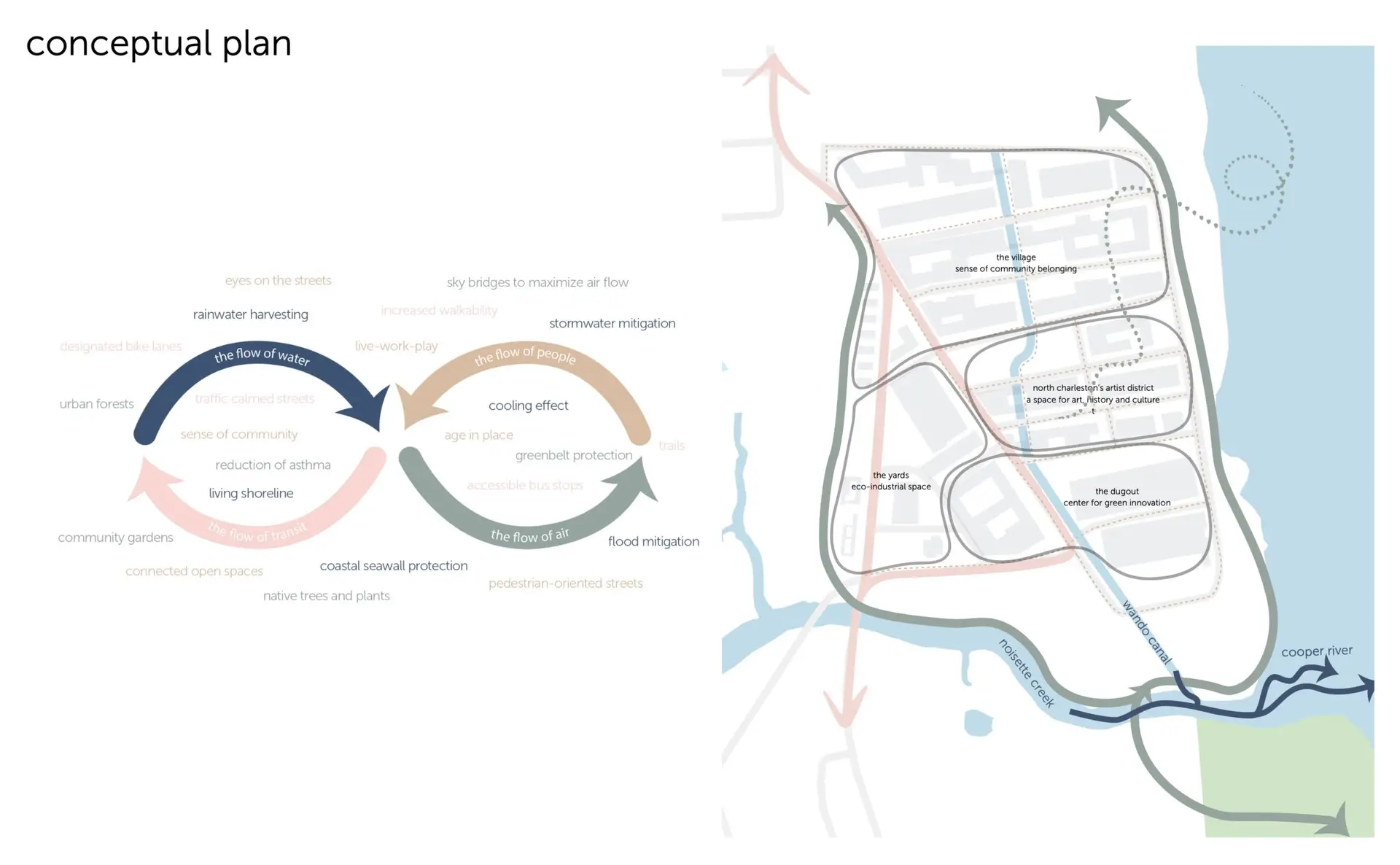
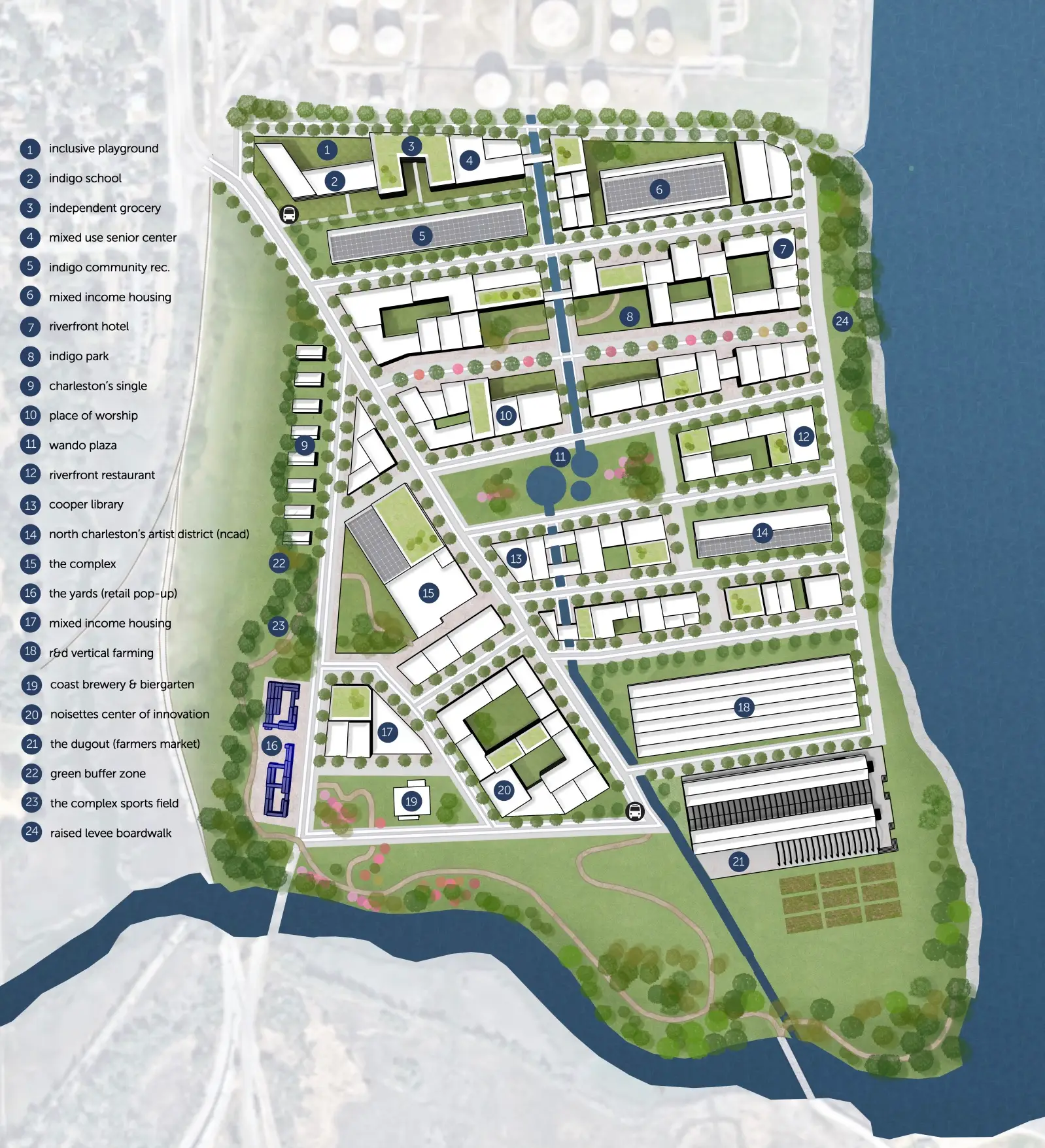
The Flow is organized around four flows: water, air, transit and people. My files from those two weeks are mostly maps and drawings: the flood risk, streets and green space, transit and regional context maps, versions of the site plan, the renders and cross sections, and the written design narrative. The pro forma was team work.
The submission was two design boards, a slide set, a site plan, two street-level views, and the pro forma with the full development program.
QGIS · Adobe Illustrator · Photoshop · InDesign · FEMA flood maps · NOAA sea level rise data · Site Planning · Urban Design · Real Estate Pro Forma (team)
We made half of the Phase I homes affordable, above the brief’s 20%, so they get built before later phases raise land values around them.
We dug a canal from Noisette Creek through the site to take in flooding and heavy rain, and lined it with parks and botanical gardens.
05
What we proposed
This was a student competition entry. None of it was built. Here is what we proposed.
- The Wando Canal, to hold stormwater and manage flooding, with new public green space, botanical gardens and walking paths.
- Streets for walking and cycling, with pedestrian-only streets, bike lanes, sky bridges and 2 new bus stops, to cut down on driving.
- Buildings based on the Charleston single house, a local house type, to let air move through in the heat.
- The Yards, a pop-up area for food and shops in reused shipping containers.
- A LEED certified development of 2.0 million square feet, built in three phases.
- Phase I at $118 million, planned to finish by the end of 2027, with 50% of homes affordable, then 20% in later phases, using incentive programs such as the Low-Income Housing Tax Credit.
06
Where it went next
- July 2024: ULI’s Women’s Leadership Initiative gave me the Alice Connell Scholarship, to attend the ULI Fall Meeting in Las Vegas that October.
- November 2024: joined ULI’s Young Leaders Group.
- September 2026: offered to advise a student team in this year’s competition, to pay it forward.