Every federal disaster since 2011, the recovery money that followed, and who represents each place
My rolePitched it, then led the data, design and build
When2024, launched 23 July; updated through 2026
WithRebuild by Design; launch covered by the Associated Press
ScaleEvery U.S. county and congressional district, plus the U.S. territories
NowLive, and in its third version
01
The question
How many federal disasters has your congressional district had since 2011, and how much recovery money followed? The answer was public. It sat in Rebuild by Design’s 600+ page Atlas of Disaster (November 2022), where it was hard for a reporter or a congressional staffer to find one district. My pitch was a map where anyone could type in an address and get that answer, next to the names of the people who represent them.
The day before launch, Greene County, New York, showed $11,487 in FEMA money per resident, the second highest in the country. I put “Under Review” next to that number on the map so nobody would quote it before it was checked.
02
The hard part
Disasters are declared by county, but members of Congress answer for districts, and the two do not line up. One county can sit in several districts. I had to join them so every district got its full count, without counting the same storm more than once.
It was also fast. I started the first version of the map on 8 May 2024, and it launched with an Associated Press story on 23 July, about eleven weeks later.
What brokeRounding the age share to one decimal shaded 14 extra counties in the older adults view. I changed the map to work from full population counts, so it matches the workbook county for county.
03
How I ran it
I launched a working map first and added to it with each new round of data.
- Spring 2024Pitch and first mapPitched turning the Atlas of Disaster into an interactive map. I started the first version on 8 May and added address search a week later.
- June to July 2024Put names on the mapAdded each place’s member of Congress and both senators, with links to reach them, and a cover that opens the state’s Atlas of Disaster report. Tested it with users and changed it based on what policymakers and reporters told us. In June I redesigned the popup into two columns, and in July I added a “click here” prompt to the report covers and a small nudge on the address search so people would find them.
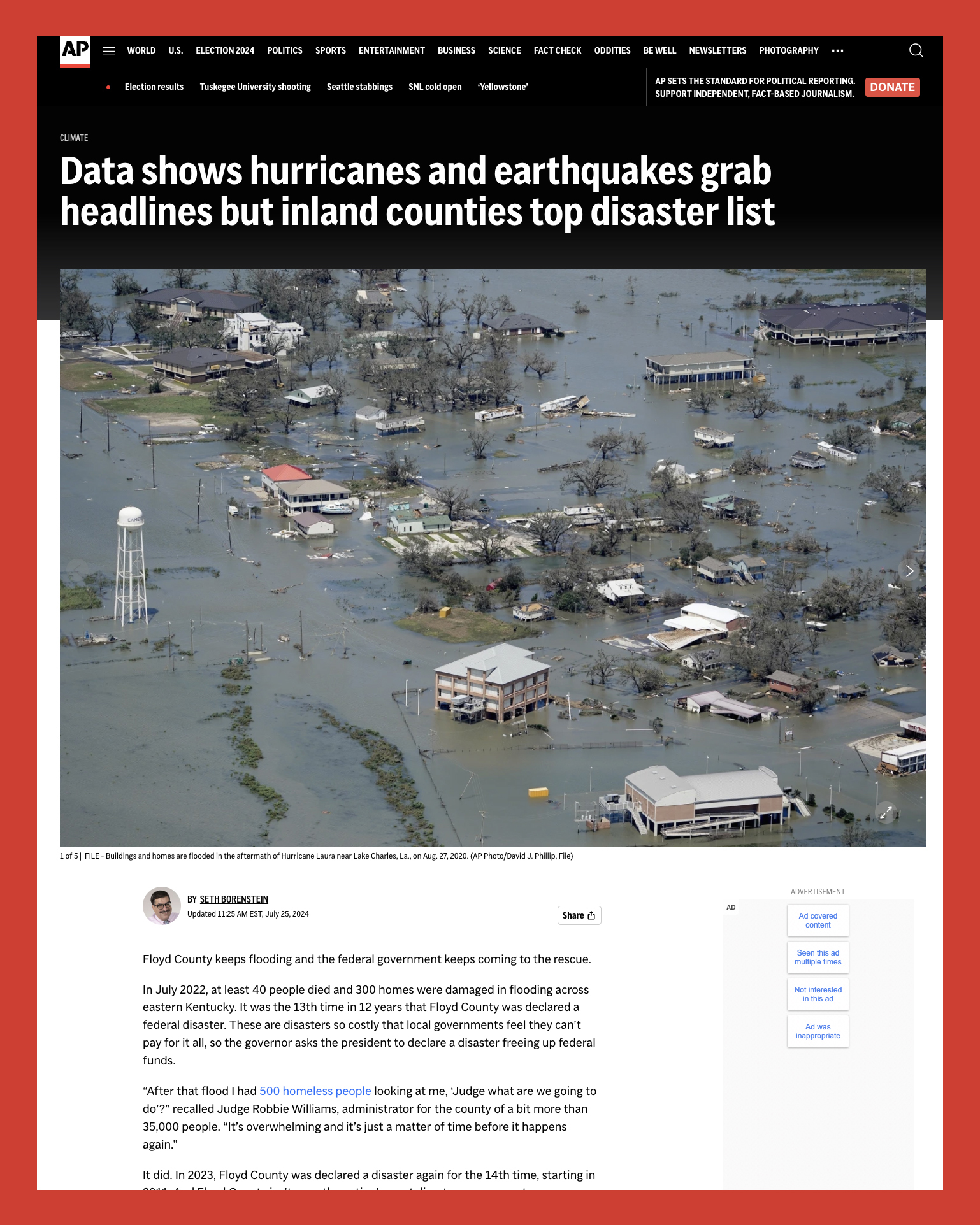
- 23 July 2024LaunchLaunched alongside an Associated Press story on which counties have had the most federal disasters.
- September 2024Territories and a full reportAdded the U.S. territories to the map, made every state map downloadable, and built a 115 page report with county numbers for every state.
- 2025 to 2026Keep it currentUpdated it for the new Congress and a fresh FEMA export in February 2025, and added 2024 disasters that October. In 2026 I rebuilt it as a third version, with new views for older adults, rural and urban counties, communities of color and tribal communities.
I counted each disaster once per district from the start, after a colleague caught one storm counted twice on our 2023 Vermont report.
04
What I built
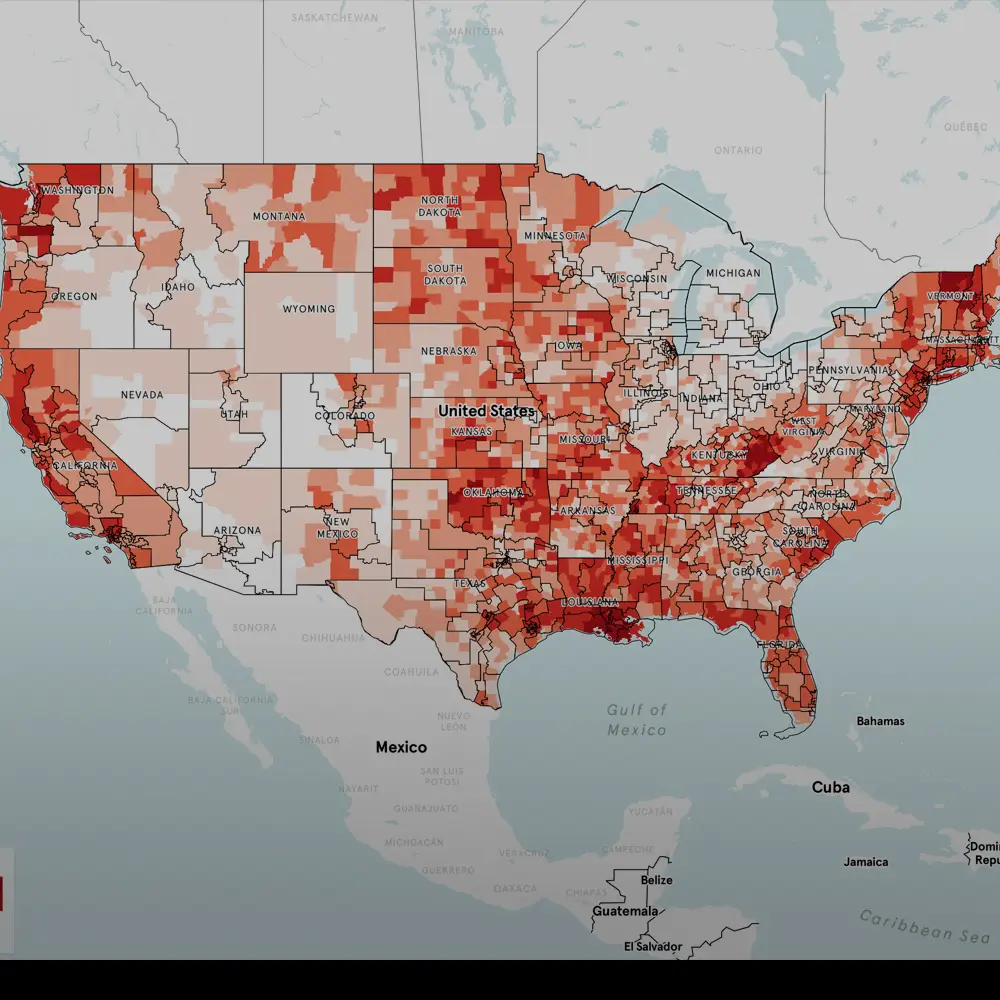
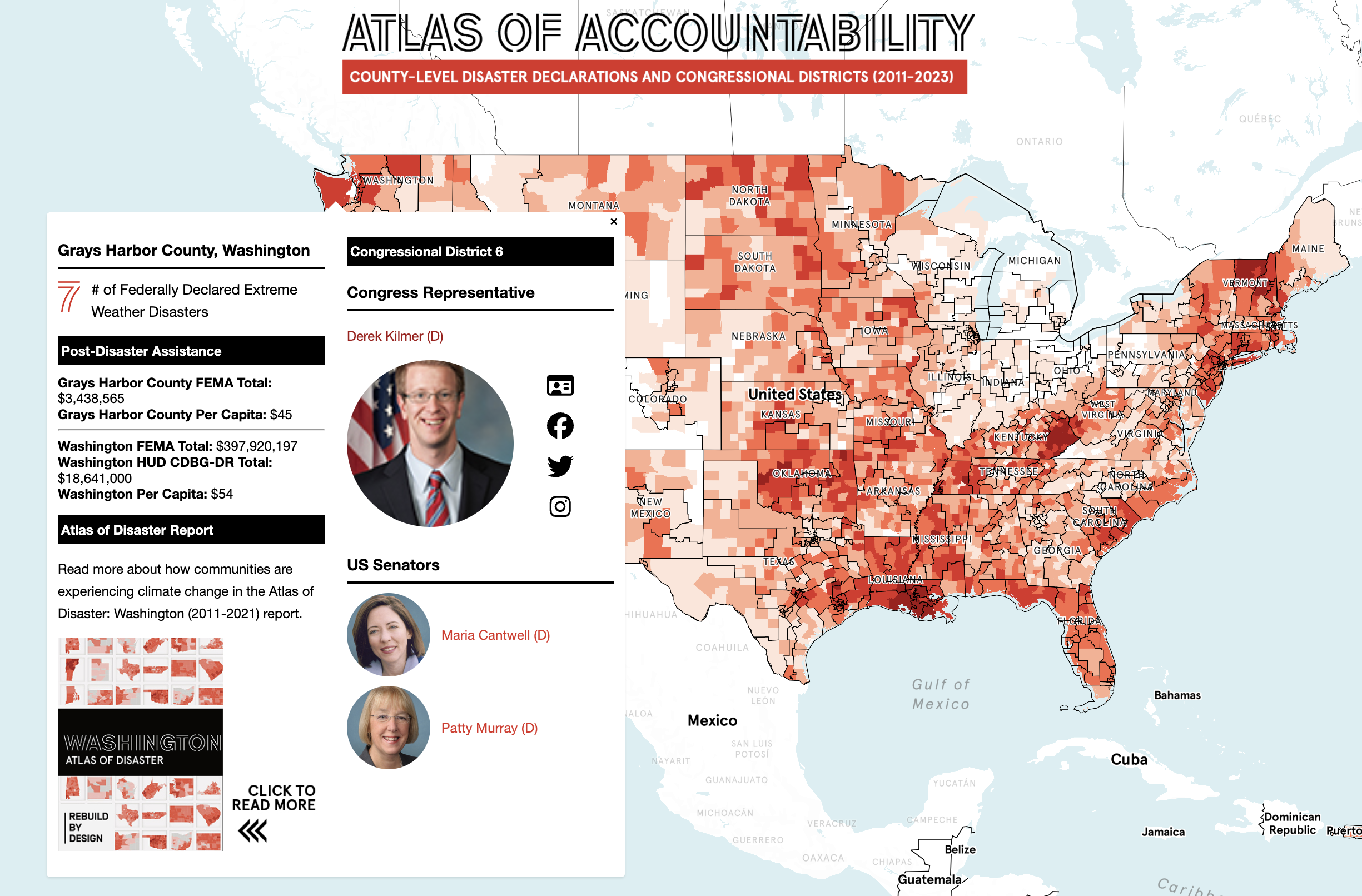
A free national map of every county’s major disaster declarations since 2011, the FEMA and HUD recovery money that followed, and that money per resident. Click a county or search an address to see its member of Congress and both senators, with links to reach them, and a cover that opens that state’s Atlas of Disaster report. It also brings in the CDC Social Vulnerability Index, a score for how hard it is for a community to recover from a disaster, and power outage data from iParametrics.
I matched every record to its county by its FIPS code, joined counties to congressional districts in QGIS, simplified the map files so the national map loads quickly in a browser, and built it in Mapbox GL JS. It builds on Rebuild by Design’s Atlas of Disaster (November 2022).
View the current Atlas of Accountability map →
View the first version of the map (2024) →
See the map on Rebuild by Design’s site →
Mapbox GL JS · QGIS · ArcGIS · GeoJSON · Python/R · Visual Studio Code · Data Wrangling · Project Management · UX/UI Design
I had the popup find the representative from the district shape under your click, so every member shows up, even in split counties.
I matched every row back to its county code, because eight workbook columns had right values in wrong rows and the national count still looked right.
05
What it found
From the 2011 to 2024 update:
- 99.5% of congressional districts have had at least one federal major disaster since 2011, in urban and rural districts, and in wealthy and poor ones.
- Recovering from these disasters has cost taxpayers $117.9 billion in federal relief: $72.7B from FEMA’s rebuilding and prevention programs (Public Assistance and Hazard Mitigation) and $45.2B from HUD’s CDBG-DR program.
- In the 2011 to 2023 data, Johnson County, Kentucky had more major disaster declarations than any other county: 15.
06
Where it went next
- 23 July 2024: launched with the Associated Press story “Data shows hurricanes and earthquakes grab headlines but inland counties top disaster list”. The same day, WKMS reported that Kentucky counties rank among the most plagued by federally declared disasters since 2011.
- 23 August 2024: CT Insider, “Extreme weather events are the new normal for CT”.
- September 2024: presented the Atlas in the UConn Sea Grant and CLEAR Climate Week webinar series. November 2024: presented it at The New York Climate Exchange’s Climate Solutions Summit on Governors Island.
- 17 April 2025: co-presented a Maps for Climate workshop hosted by the University of Illinois Chicago’s Urban Data Visualization Lab.
- The Society of Environmental Journalists hosted a webinar teaching reporters to find local disaster stories in the Atlas.
- 2026: a third version of the map, with views for older adults, rural and urban counties, communities of color and tribal communities.