A plan for investing in Brownsville and Chinatown that serves the people who already live there
My roleResearched, wrote and designed the paper on my own
WhenSpring 2024, handed in May 2024
WithNYU Wagner course taught by Tim Tompkins and Rasmia Kirmani
ForA new New York City mayor, as the course asked
Run asA 9 slide first version in April, rebuilt into a 23 page paper in May
01
The question
If the city puts money into Brownsville and Chinatown, how does it make sure the people who live there now are the ones who benefit? The course asked each of us for a plan for a new mayor on how the city can grow fairly. I wrote mine around that question, as a list of principles with a specific step for each neighborhood.
I opened the paper by asking the city to admit where it has let these neighborhoods down, and to apologize, before asking people to trust a new plan.
02
The hard part
The two neighborhoods have almost opposite problems. In Brownsville the median household income was $20,300, more than 30% of people lived below the poverty line, and children went to the emergency room for asthma at more than double the city rate. In Chinatown the population fell 3% between 2010 and 2020, the Asian population fell 15%, and people 65 and over grew by 24% to a quarter of the neighborhood. Brownsville has had too little investment for a long time, while in Chinatown new investment and rising costs are pushing long-time residents and their culture out.
One set of principles had to work for both, without treating them as the same place. And because the class was about partnerships, the plan also had to show how the city would work with nonprofits and businesses to get things done. My first version, a 9 slide deck in April, had housing as its own principle and a principle on technology. By May I had folded housing into building for people, cut technology, and given young people a principle of their own.
03
How I ran it
- January to March 2024Read and walkWeekly readings and guest speakers on parks, public housing, the business groups that manage commercial streets, and who governs a place. The first assignment was a walk along Allen Street on the Lower East Side.
- Spring 2024Profile both placesPulled 2010 to 2020 census numbers for each neighborhood from the city’s Population FactFinder, plus the city’s Brownsville Plan, so every step could point back to a real need.
- April 2024Present a first versionA 9 slide deck, “Revitalizing Roots and Raising Resilience,” with five principles, presented to classmates and both professors for feedback.
- April to May 2024Rebuild the principlesHousing moved inside a broader principle about building for people, the technology principle came out, and young people became a principle of their own.
- May 2024Write and design itWrote the final paper and laid it out in InDesign as a 23 page magazine, then published it online so anyone could read it.
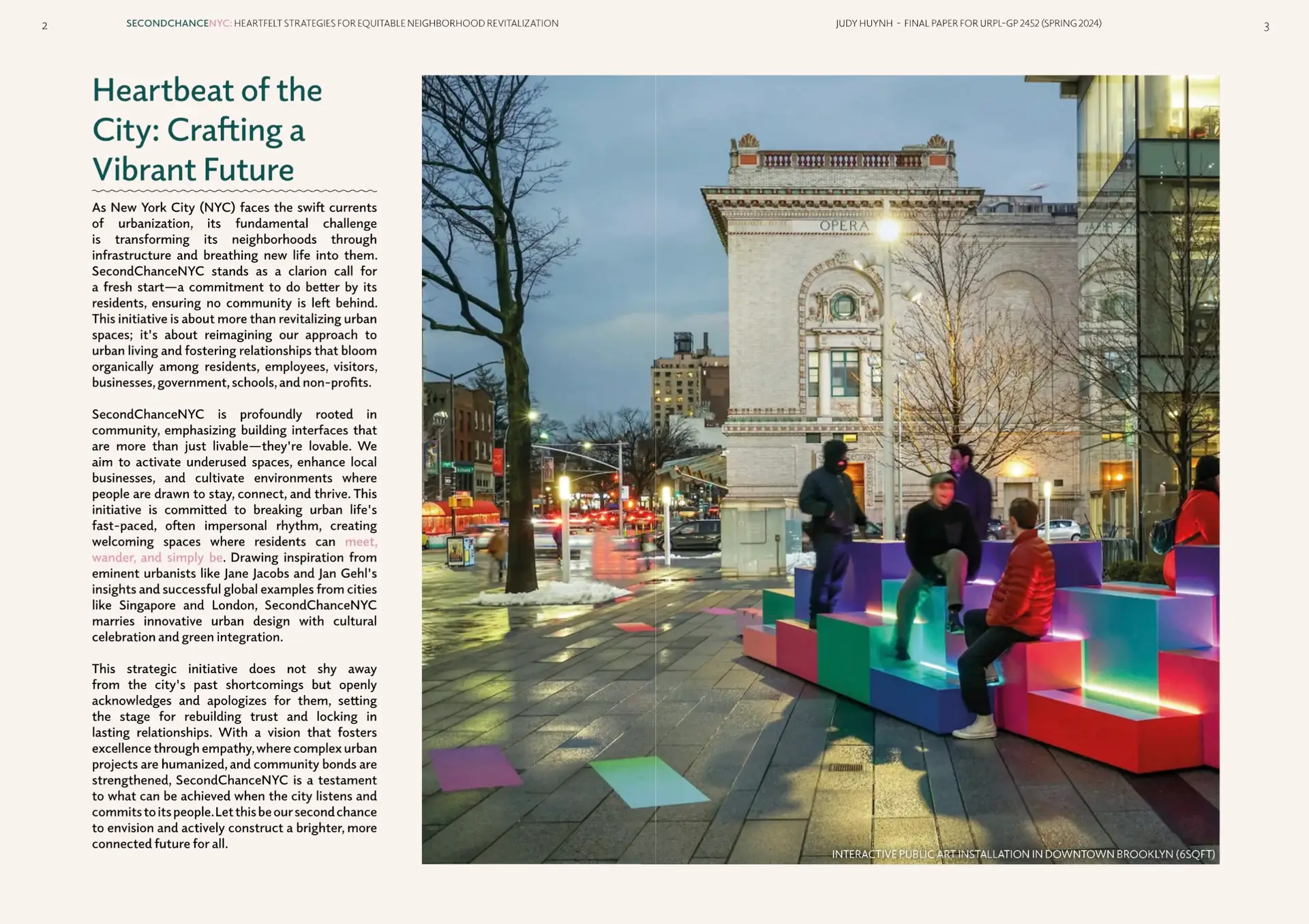
I dropped Times Square, which already has a well-funded business group, because Brownsville and Chinatown’s opposite problems better tested one set of principles.
04
What I built
SecondChanceNYC is my final paper for Public-Private Partnerships, Public Spaces, Politics and the Press at NYU Wagner. It drew on my international travels, lived experiences, academic studies and professional work. It sets out five principles, gives each one a step for Brownsville and a step for Chinatown, points to a working example from another city, and ends with ways to measure whether it is working.
Adobe InDesign · NYC Population FactFinder · Census Data · Policy Research · Case Studies · Editorial Design
I tied each step to a neighborhood number, like pairing childcare with business training for women because women are 58% of Brownsville.
I said how to measure it, because a plan for a mayor needs a way to tell if it worked.
05
What I proposed
- Build for people first. Walking routes in Brownsville, community hubs and bus rapid transit along Canal Street, and housing built with nonprofits through community land trusts.
- Culture as a strength. An immersive art project in Brownsville with The Brownsville Project, modeled on London’s “The Happy House,” and cooking classes led by local chefs in Chinatown.
- Green infrastructure. Gardens and planted zones in Brownsville aimed at its high asthma rates, and parks in Chinatown that work for every age.
- Young people. A learning hub in Brownsville with job training through FutureReadyNYC, and a “First Gen” program for Chinatown students who are the first in their families to go to college.
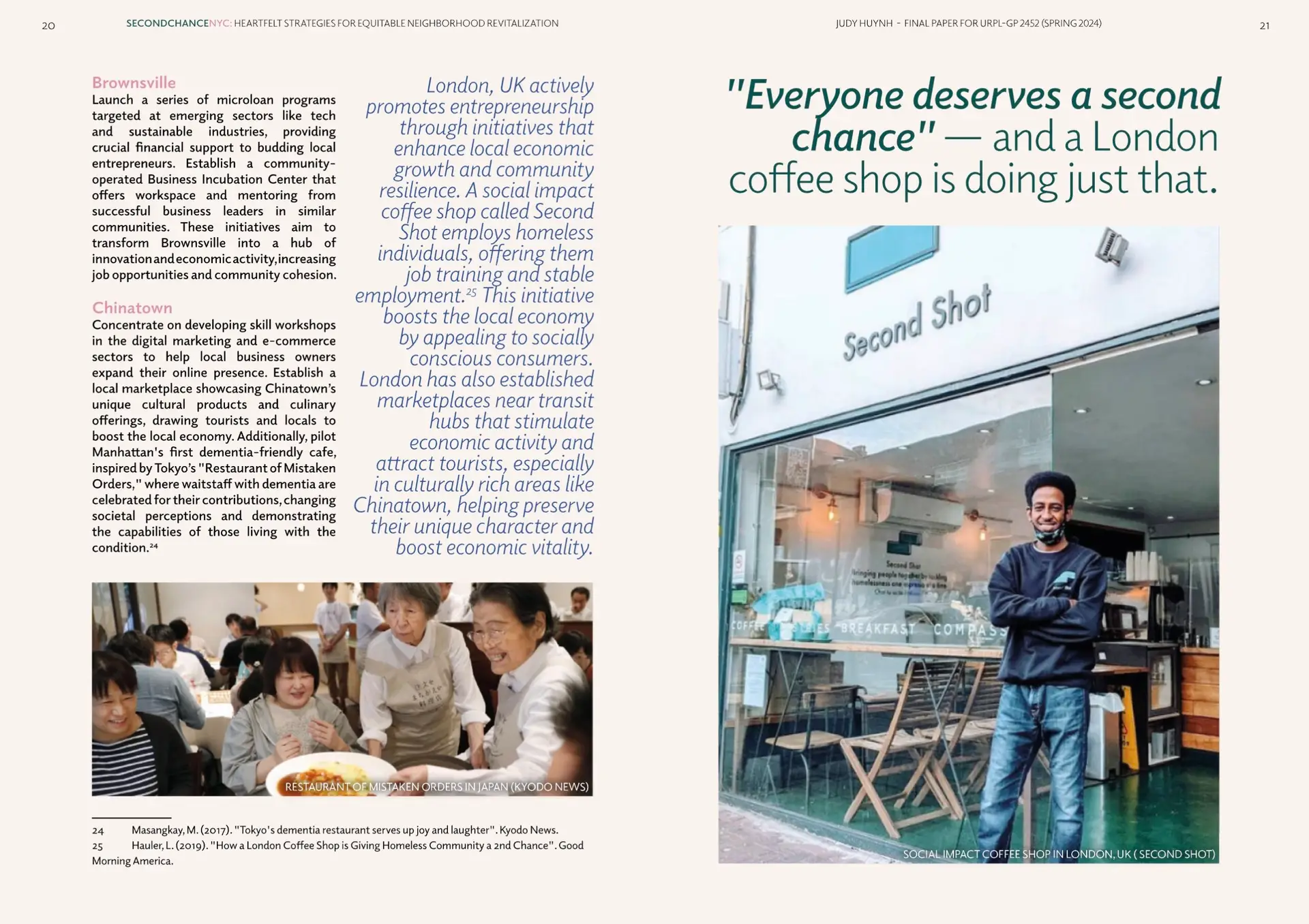
- Local business. Small loans and a shared workspace in Brownsville where new businesses get mentoring. In Chinatown, online selling workshops, a local marketplace, and Manhattan’s first dementia friendly cafe, after Tokyo’s Restaurant of Mistaken Orders.
06
Where it went next
- May 2024: handed in as my final paper, the spring I finished my Master of Urban Planning at NYU Wagner.
- January 2025: when I started teaching at NYU Wagner, I named it as one of the projects that shaped my planning philosophy.